Massive Cloud Band Signals Relief From Extreme Heat Across Northern India
Northern India continued to reel under an intense heatwave on Thursday as temperatures soared across several states. In a striking development, Rajasthan’s Sri Ganganagar recorded 48.2 degrees Celsius, reportedly making it one of the hottest places in the world on the day when millions celebrated Eid. However, meteorologists now believe that significant weather relief may finally be approaching.
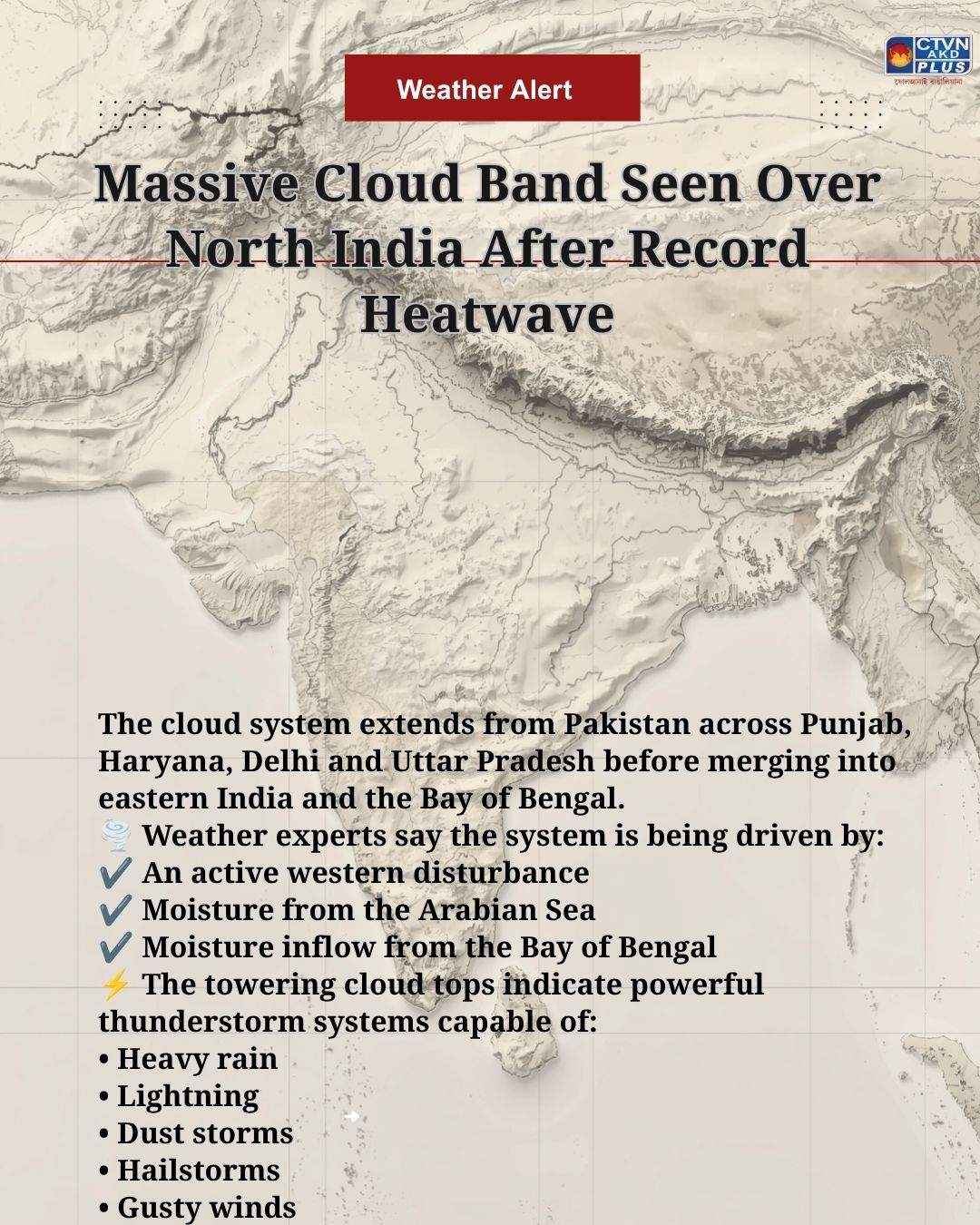
Fresh thermal infrared imagery captured by India’s INSAT-3DS weather satellite has revealed a massive cloud band stretching across large parts of northern and central India. The expansive system extends from Pakistan and northwest India through Punjab, Haryana, Delhi and Uttar Pradesh before connecting with cloud clusters over eastern India and the Bay of Bengal.
Weather experts say the formation is linked to an active western disturbance interacting with moisture flowing in from both the Arabian Sea and the Bay of Bengal. This combination has created strong atmospheric instability after days of extreme surface heating across the Indo-Gangetic plains.
The satellite imagery shows dense cloud structures spread over an estimated distance of nearly 2,000 to 2,500 kilometres, making it one of the largest pre-monsoon cloud systems observed this season. The brightest white portions visible in the infrared imagery represent extremely cold cloud tops, indicating the presence of towering thunderstorm systems rising high into the atmosphere.
Such systems are often capable of producing heavy rainfall, thunderstorms, lightning, hailstorms and strong gusty winds. Meteorologists warn that these developing mesoscale convective systems can intensify rapidly when hot land surfaces interact with incoming moisture during the pre-monsoon period.
Another important feature visible in the satellite image is a cyclonic swirl over northern Pakistan and adjoining Jammu and Kashmir. This circulation is believed to be associated with an active western disturbance moving through the western Himalayan region. As the system continues to pull moisture inland, widespread clouding and thunderstorm activity are expected to increase across north India.
The evolving weather pattern indicates that the atmosphere is transitioning rapidly after prolonged heatwave conditions across Rajasthan, Delhi, Haryana and parts of central India. The combination of high temperatures and increasing moisture is creating ideal conditions for explosive thunderstorm development.
According to weather forecasts, several parts of north India may witness thunderstorms, dust storms, lightning activity and scattered rainfall over the coming days. Hill states including Himachal Pradesh, Uttarakhand and Jammu and Kashmir are also likely to experience moderate to heavy rain under the influence of the western disturbance.
Meanwhile, the southwest monsoon continues its gradual advance over southern seas surrounding India. Although the monsoon has not yet officially reached northern India, the increasing cloud activity suggests that moisture transport into the northern plains is intensifying earlier than expected.
For millions suffering under relentless heat, the developing cloud systems may finally bring temporary relief and mark the beginning of a major seasonal transition across the region.