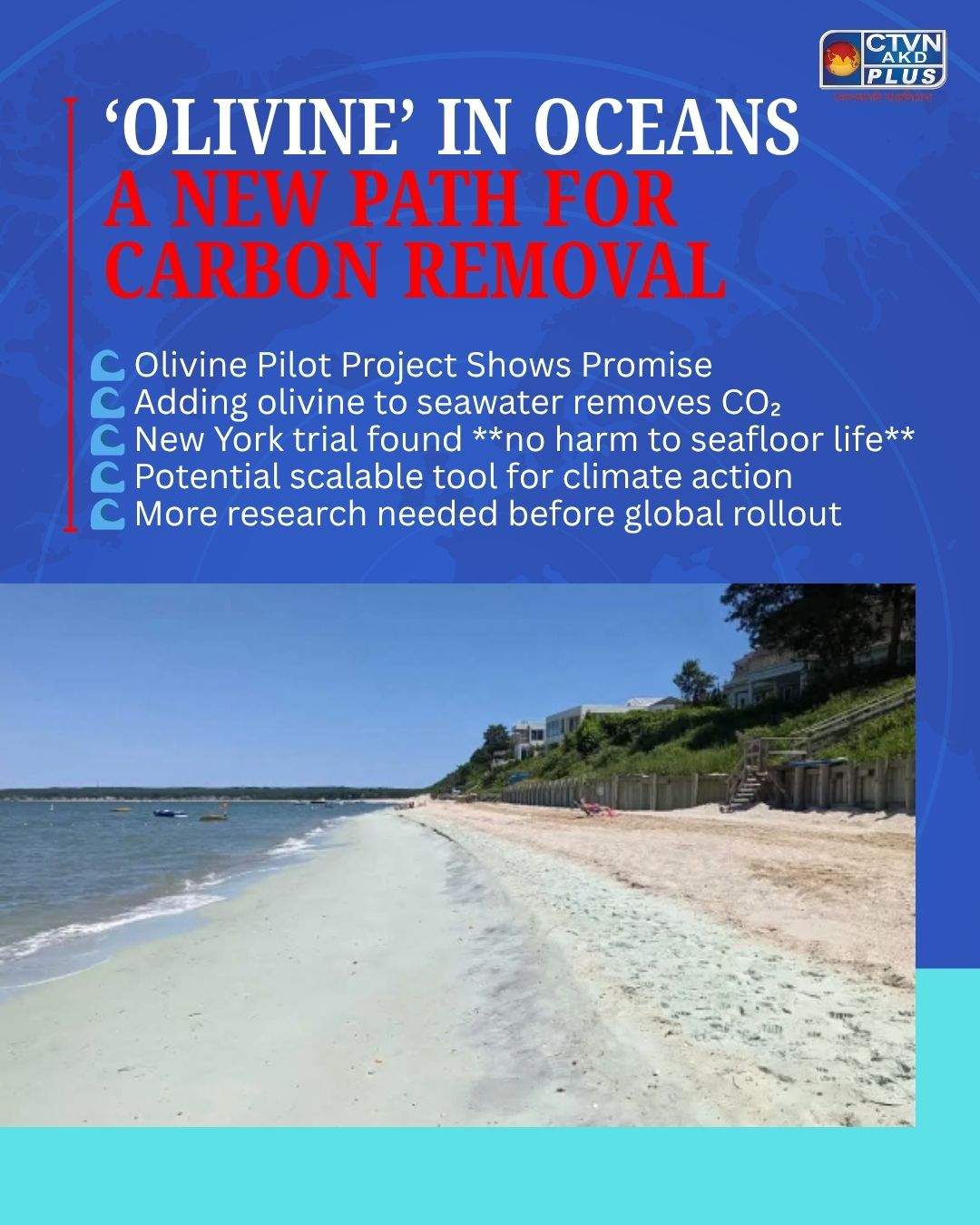
'Olivine' in Oceans: A New Path for Carbon Removal
A promising climate solution is emerging from the ocean floor. Scientists have long theorized that adding olivine, a naturally occurring green mineral, to seawater could accelerate carbon dioxide removal from the atmosphere. Olivine reacts with seawater through a process called enhanced weathering, converting CO₂ into stable bicarbonates that remain dissolved in the ocean for thousands of years.
A pilot project in New York state recently tested this idea by dispersing olivine along the seafloor. The results were encouraging: researchers found no signs of adverse effects on marine organisms living in the sediment. This outcome is significant, as ecological safety has been one of the biggest concerns surrounding ocean-based carbon removal strategies.
The potential of olivine lies in its scalability. Vast quantities of the mineral are available globally, and its natural weathering process is already part of Earth’s carbon cycle. By accelerating this reaction, humanity could create a powerful tool to offset emissions. Importantly, the pilot project suggests that such interventions may be environmentally safe, at least at small scales.
However, scientists caution that more research is needed. Long-term monitoring, larger-scale trials, and careful evaluation of ecological impacts will be essential before olivine deployment can be considered a mainstream climate solution. Questions remain about logistics, costs, and the energy required to mine and distribute the mineral.
Still, the findings from New York mark a hopeful step forward. As the world searches for effective ways to combat climate change, ocean-based carbon removal strategies like olivine weathering could become part of a diverse toolkit to stabilize the planet’s atmosphere.
#ClimateAction #CarbonRemoval #Olivine #OceanSolutions