Rafale vs J-10CE: South Asia’s Air Power Race
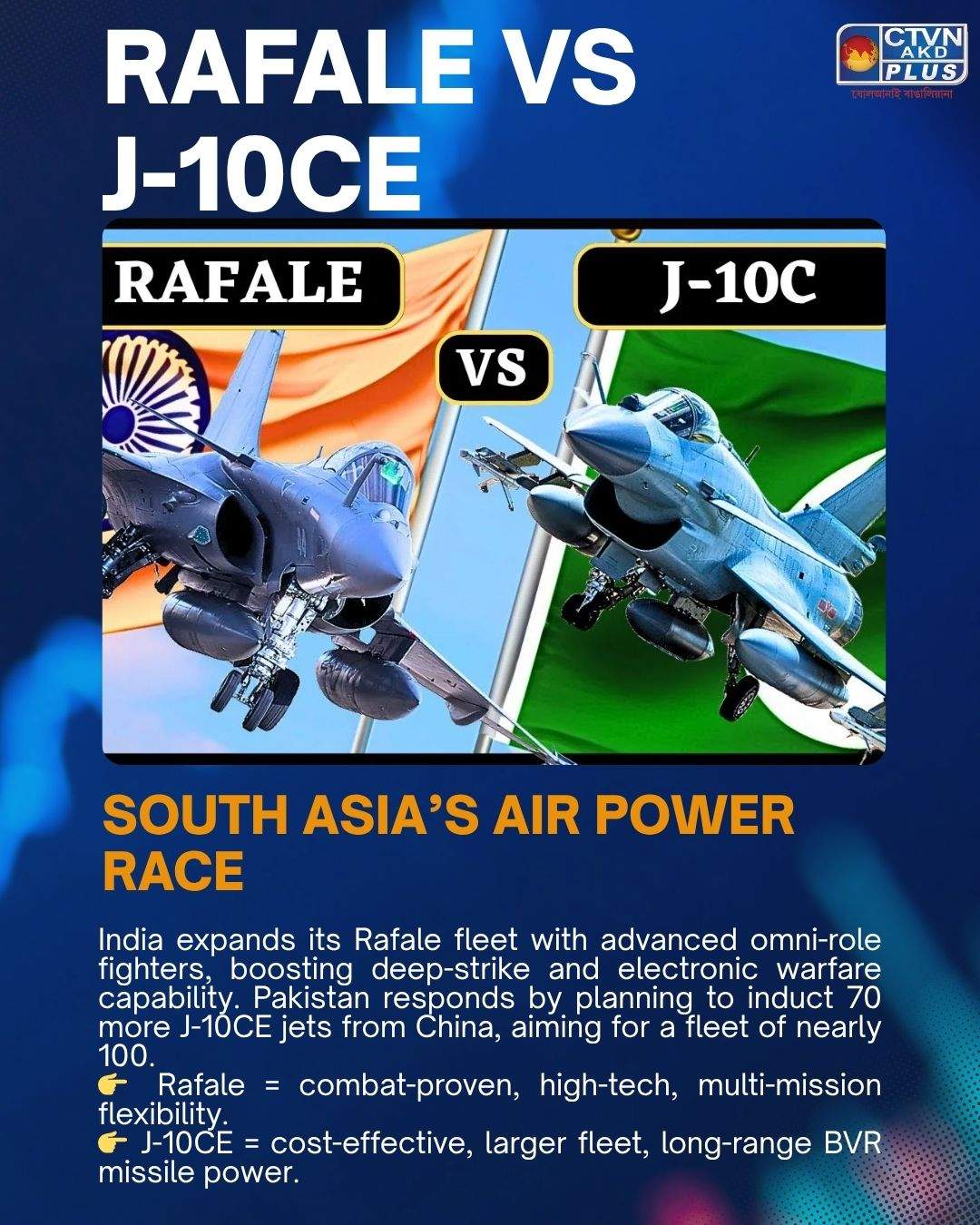
The expansion of India’s Rafale fleet has triggered a significant response from Pakistan, highlighting the intensifying air power competition in South Asia. India’s decision to acquire additional Rafale fighter jets from France strengthens its omni-role combat capability, giving the Indian Air Force (IAF) a technological edge with advanced electronic warfare systems, sensor fusion, and deep-strike potential. The Rafale has already proven its effectiveness in multiple combat theatres, making it a formidable platform for India’s defense strategy.
In reaction, Pakistan is moving to expand its fleet of Chengdu J-10CE fighter jets from China. Reports suggest Islamabad is considering a follow-on order of 60 to 70 aircraft, which would raise its total J-10CE strength to nearly 100. This expansion reflects Pakistan’s emphasis on quantity and affordability, enabling the Pakistan Air Force (PAF) to conduct more sorties, maintain wider combat air patrols, and execute coordinated beyond-visual-range (BVR) engagements. The J-10CE, equipped with AESA radar and PL-15 long-range missiles, fits into Pakistan’s strategy of stand-off warfare, where targets are engaged from a distance rather than through close-range dogfights.
The Rafale-J-10CE dynamic illustrates two contrasting approaches: India’s focus on quality and advanced systems versus Pakistan’s reliance on larger numbers and cost-effective platforms. While Rafale offers superior electronic warfare and multi-mission flexibility, the J-10CE provides Pakistan with a scalable solution to strengthen its aerial presence. Strategically, this arms race underscores the shifting balance of power in the region, with both nations investing heavily in modern platforms and network-centric warfare capabilities. The outcome is a more complex and potentially volatile security environment in South Asia, where air superiority will play a decisive role in future conflicts.