The Return of America’s “Doomsday Plane”
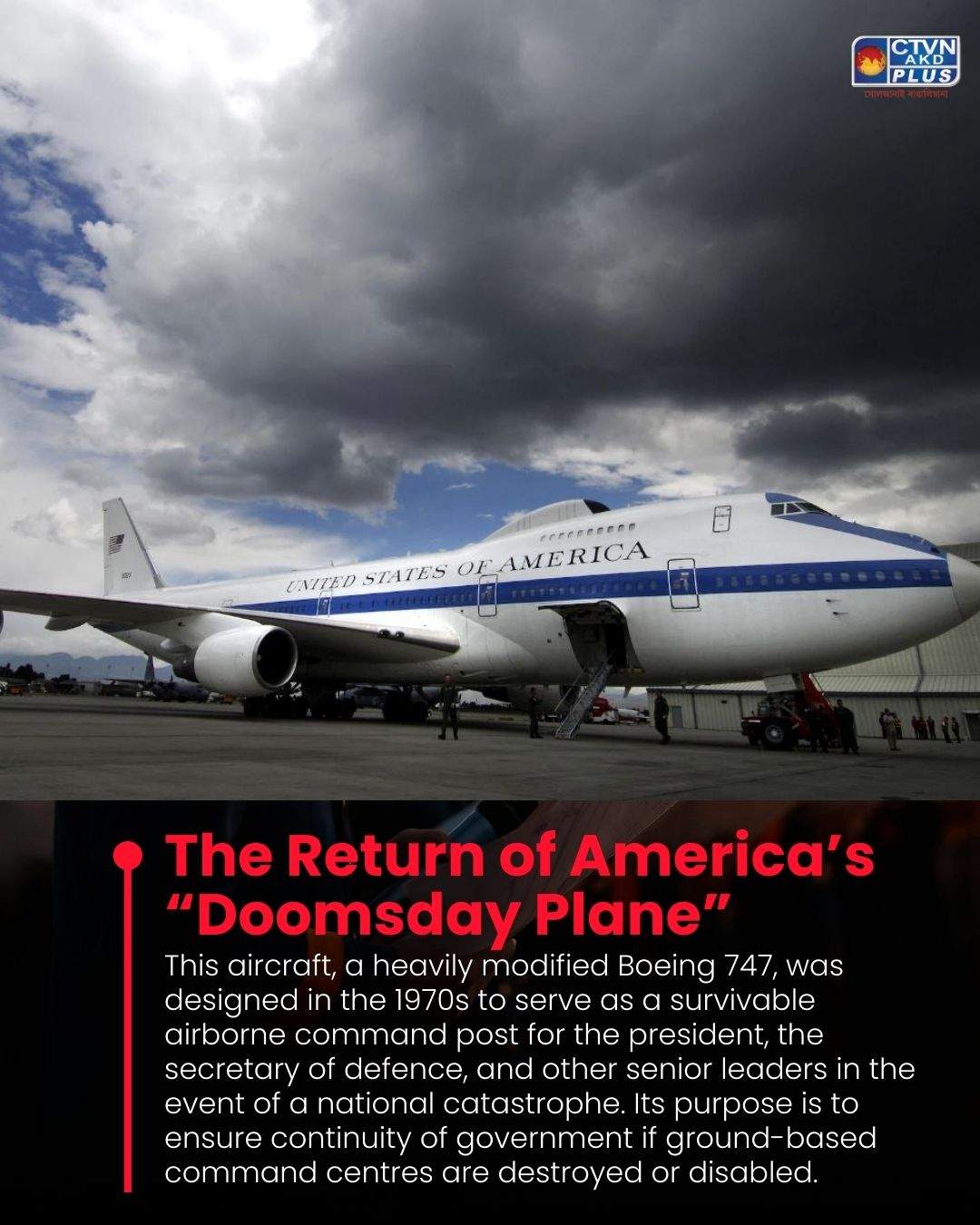
The United States Air Force’s Boeing E‑4B Nightwatch, often nicknamed the “doomsday plane,” has reappeared in public view after decades of relative invisibility, sparking renewed interest and speculation. This aircraft, a heavily modified Boeing 747, was designed in the 1970s to serve as a survivable airborne command post for the president, the secretary of defence, and other senior leaders in the event of a national catastrophe. Its purpose is to ensure continuity of government if ground-based command centres are destroyed or disabled.
Technically, the E‑4B is hardened against electromagnetic pulses (EMP) and equipped with multiple redundant communication systems, ranging from satellite links to secure landlines. It can be refuelled mid‑air, allowing it to remain aloft for days, and its interior includes conference rooms and operations centres capable of supporting a large mission crew. These features earned it the moniker “Flying Pentagon,” symbolizing its role as a mobile fortress of command and control.
The recent sighting of the E‑4B near major U.S. hubs such as Washington, D.C., and Los Angeles drew attention because public landings are rare. Its appearance coincided with heightened global tensions, leading to speculation about whether the aircraft was deployed in response to crisis. Defence analysts, however, caution that such flights are often routine — for training, maintenance, or positioning ahead of exercises — and do not necessarily signal imminent conflict.
Historically, the E‑4B has been used publicly only a handful of times, most notably during the chaotic hours following the September 11 attacks, when airborne command capability proved essential. While the Air Force is developing a modern replacement known as the Survivable Airborne Operations Centre, the E‑4B remains the backbone of America’s contingency planning. Its reemergence underscores both its rarity and its symbolic weight as a lifeline for national leadership in times of crisis.