India’s Pralay Salvo Launch Strengthens India’s Strike Capabilities
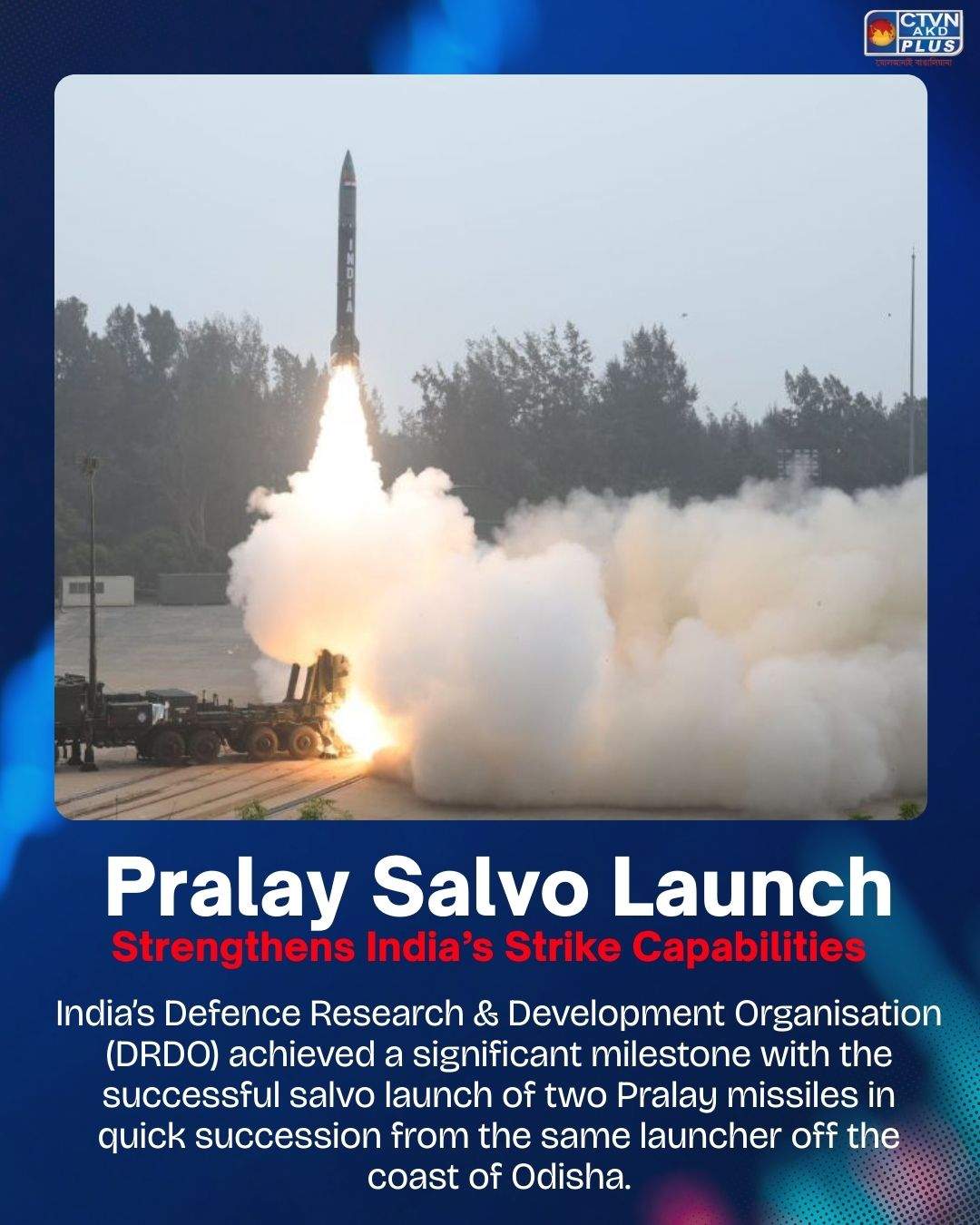
India’s Defence Research & Development Organisation (DRDO) achieved a significant milestone with the successful salvo launch of two Pralay missiles in quick succession from the same launcher off the coast of Odisha. Conducted as part of user evaluation trials, the test demonstrated the missile’s reliability and readiness for induction into the armed forces. Defence Minister Rajnath Singh commended DRDO, the Indian Air Force, the Indian Army, and industry partners for their role in the achievement, noting that the successful salvo launch established confidence in the system’s operational effectiveness.
According to the Ministry of Defence, both missiles followed their intended trajectories and met all flight objectives. Tracking sensors at the Integrated Test Range in Chandipur confirmed the results, while telemetry systems onboard ships validated the terminal events near the impact points.
The Pralay missile is an indigenously developed solid‑propellant quasi‑ballistic missile designed for precision strikes. It employs advanced guidance and navigation systems and is capable of carrying multiple types of warheads against diverse targets. Developed by Research Centre Imarat, Hyderabad, in collaboration with several DRDO laboratories and production partners such as Bharat Dynamics Limited and Bharat Electronics Limited, the missile reflects India’s growing self‑reliance in advanced defence technology.
One of the key strengths of Pralay lies in its ability to deliver high‑precision strikes while evading interception. Its successful salvo launch demonstrates the system’s capacity for rapid, successive firing—an essential feature for overwhelming adversary defences. Defence planners view the missile as a critical addition to India’s arsenal, particularly for countering threats along sensitive borders.
DRDO Chairman Samir V. Kamat congratulated the teams involved, emphasizing that the achievement signals imminent readiness for induction. With Pralay, India strengthens its layered deterrence posture, enhancing both strategic depth and operational flexibility in the face of regional challenges.