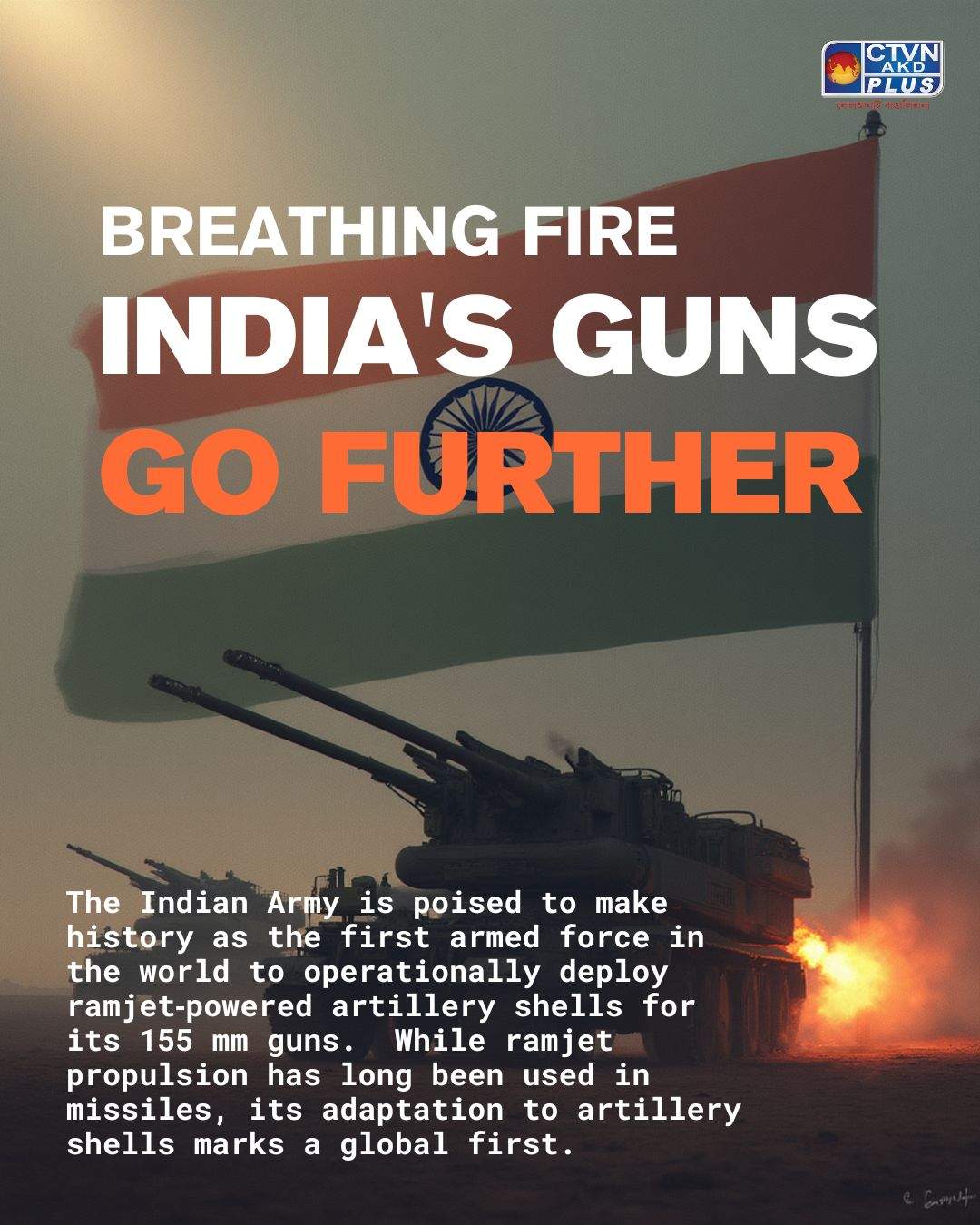
India’s Ramjet Artillery Breakthrough
The Indian Army is poised to make history as the first armed force in the world to operationally deploy ramjet‑powered artillery shells for its 155 mm guns. This pioneering technology, developed in collaboration with IIT Madras and supported by the Army Technology Board, represents a revolutionary leap in artillery warfare. While ramjet propulsion has long been used in missiles, its adaptation to artillery shells marks a global first.
At the heart of the innovation is the ramjet engine—an air‑breathing system that requires no turbines or compressors. Once the shell is fired at speeds of around Mach 2, incoming air is naturally compressed, fuel is ignited, and thrust is generated. This allows the shell to sustain propulsion far beyond the limits of conventional ammunition. With a specific impulse exceeding 4000 N·s/kg, compared to roughly 2500 N·s/kg for solid rockets, ramjet shells deliver significantly greater overall impulse for the same propellant mass.
The technology promises to extend the effective range of standard artillery by 30–50 percent while maintaining destructive power. This capability enables the Army to strike deeper targets with precision, enhancing deterrence and battlefield flexibility. Importantly, trials at Pokhran have demonstrated that ramjet modules can be retrofitted onto existing 155 mm shells, ensuring compatibility across the Army’s current inventory without requiring entirely new designs.
For India, the breakthrough is emblematic of the Atmanirbhar Bharat initiative, showcasing indigenous innovation in defense technology. It also positions the country at the forefront of global artillery modernization. Once inducted, ramjet shells could be deployed across platforms including the M777 ultra‑light howitzer, amplifying India’s firepower in diverse terrains.
In essence, the ramjet artillery project is not just a technological milestone—it is a strategic statement. By extending the reach of its guns, India is extending the reach of its sovereignty and signaling its readiness for future conflicts.