India’s Headache – Pakistan’s AIP Submarines
The maritime rivalry between India and Pakistan has traditionally been defined by geography, naval doctrine, and technological asymmetry. However, Pakistan’s acquisition and planned induction of Air-Independent Propulsion (AIP) submarines has introduced a new dimension to this contest, posing a significant challenge to India’s naval strategy and security calculus.
What Are AIP Submarines?
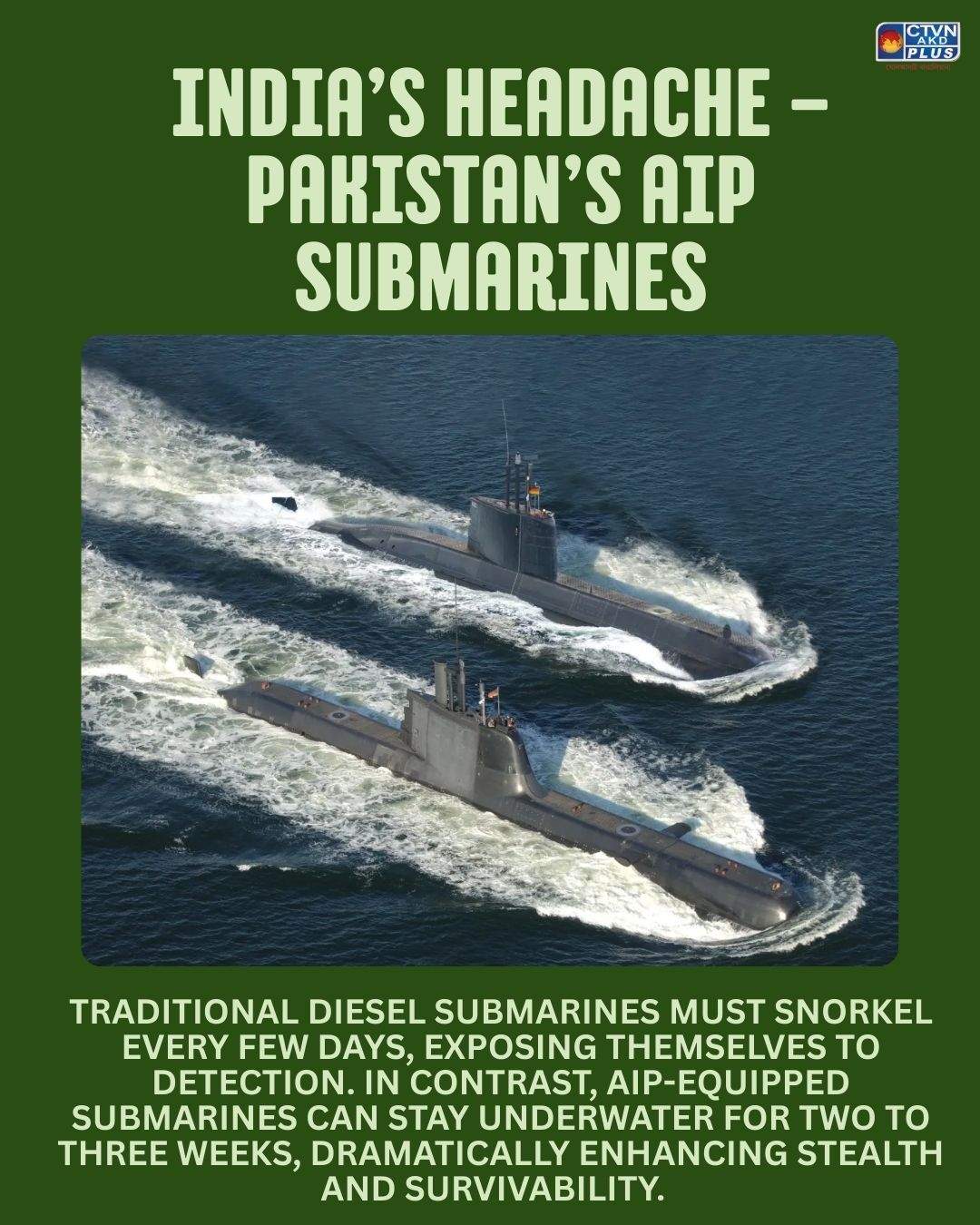
Air-Independent Propulsion (AIP) technology allows conventional diesel-electric submarines to remain submerged for extended periods without surfacing to recharge their batteries. Traditional diesel submarines must snorkel every few days, exposing themselves to detection. In contrast, AIP-equipped submarines can stay underwater for two to three weeks, dramatically enhancing stealth and survivability.
Technically, AIP systems generate electricity underwater without atmospheric oxygen. Pakistan’s upcoming submarines are expected to use Stirling engines or fuel-cell technology, both of which are quieter and harder to detect. Fuel cells, for instance, combine hydrogen and oxygen to produce electricity with minimal noise, while Stirling engines use liquid oxygen and fuel to drive generators. These systems reduce acoustic signatures, making detection by sonar or radar far more difficult.
Pakistan’s Naval Modernization
Pakistan has contracted with China for eight Hangor-class submarines, based on the Chinese Type 039A/041 Yuan-class design, equipped with AIP modules. Four will be built in China, and four in Pakistan, enhancing local shipbuilding capacity. These submarines are expected to be delivered by the early 2030s, significantly boosting Pakistan’s undersea warfare capabilities.
The Hangor-class submarines will reportedly feature:
- AIP modules for extended underwater endurance.
- Advanced sonar systems for detection and tracking.
- Capability to launch cruise missiles, potentially including nuclear-capable variants.
- Improved stealth design, reducing radar and acoustic signatures.
India’s Strategic Challenge
For India, Pakistan’s AIP submarines represent a serious headache. The Indian Navy has traditionally relied on a mix of nuclear-powered submarines (Arihant-class SSBNs) and conventional diesel-electric submarines (Scorpène-class). While India is developing its own AIP modules for future Scorpène upgrades, Pakistan’s rapid induction of Chinese-built AIP submarines threatens to tilt the balance in the Arabian Sea.
The key challenges for India include:
- Stealth Factor: AIP submarines can lurk undetected near Indian shipping lanes or naval bases, complicating surveillance.
- Extended Endurance: Weeks of underwater operation mean Pakistan can sustain patrols and ambush positions longer than India’s current diesel fleet.
- Missile Capability: If armed with cruise missiles, these submarines could threaten Indian coastal infrastructure and naval assets.
- Regional Deterrence: Pakistan’s undersea fleet, backed by Chinese technology, enhances its deterrence posture against India’s superior surface fleet.
Technical Countermeasures
India is responding by:
- Accelerating the induction of indigenous AIP modules into Scorpène-class submarines.
- Expanding its fleet of nuclear-powered submarines, which remain unmatched in endurance.
- Investing in anti-submarine warfare (ASW) assets, including P-8I Poseidon aircraft, advanced sonar arrays, and underwater drones.
- Strengthening cooperation with allies like the U.S. and France for technology transfer and joint exercises.
Conclusion
Pakistan’s AIP submarines represent more than a technological upgrade; they are a strategic lever that complicates India’s maritime dominance. By extending underwater endurance, enhancing stealth, and potentially carrying cruise missiles, these submarines pose a formidable challenge to India’s naval security. For New Delhi, the headache lies not only in countering the immediate threat but also in ensuring that its own submarine fleet evolves rapidly enough to maintain deterrence and superiority in the Indian Ocean.