India Dominates Military Strength Rankings as Pakistan Declines
The 2026 Global Firepower (GFP) rankings have reaffirmed India’s position as one of the world’s leading military powers, while Pakistan continues to slide down the list. The GFP index, which evaluates 145 countries based on more than 60 factors including manpower, equipment, logistics, and geography, assigns lower scores to stronger war‑fighting capabilities.
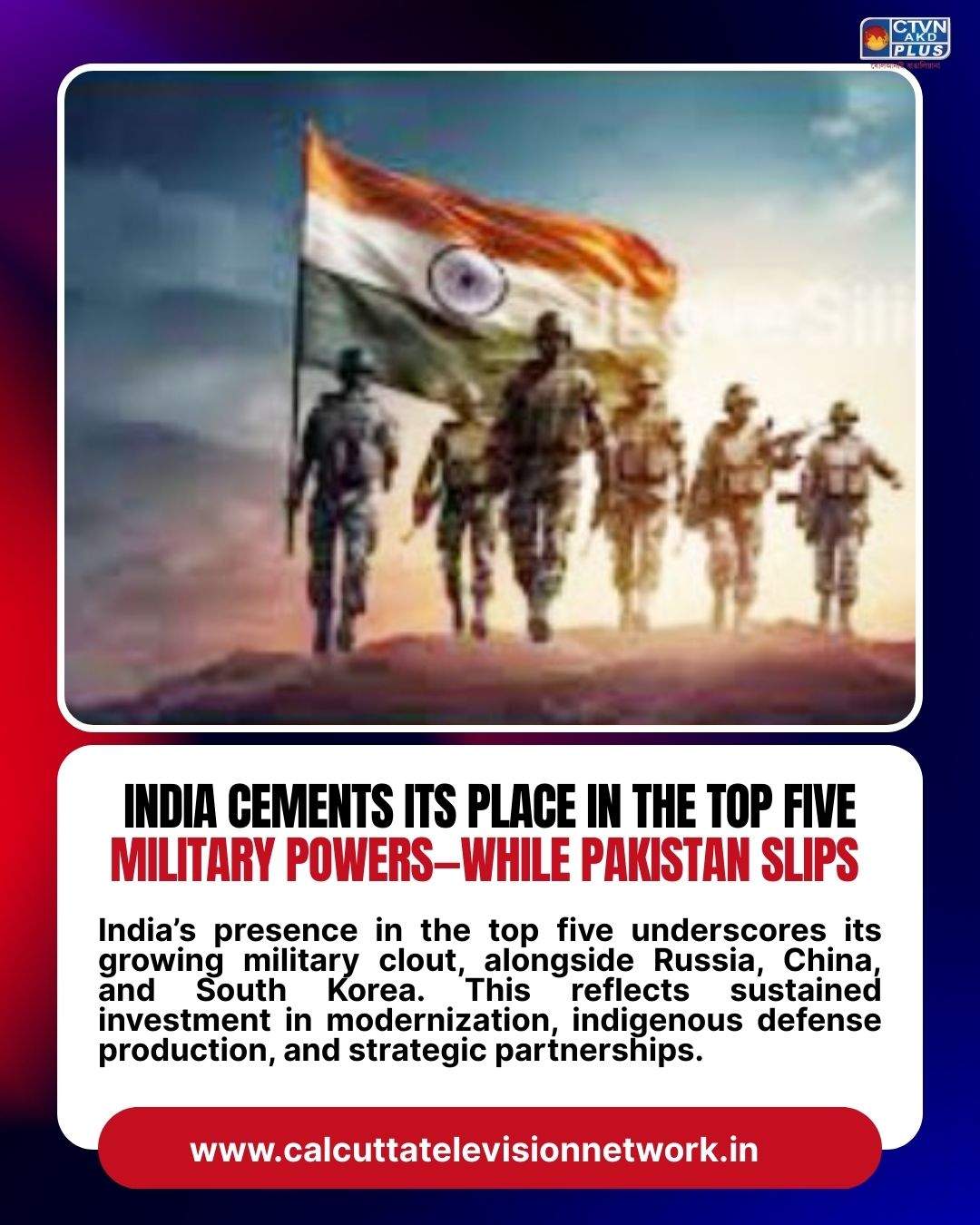
India’s presence in the top five underscores its growing military clout, alongside Russia, China, and South Korea. This reflects sustained investment in modernization, indigenous defense production, and strategic partnerships. For New Delhi, the ranking is not just symbolic—it strengthens its global standing amid rising geopolitical uncertainty and regional tensions.
Russia and China retained their second and third positions, with PwrIndx scores of 0.0791 and 0.0919 respectively, highlighting their formidable conventional capabilities. France’s steady climb to sixth place, from 11th in 2024, signals Europe’s renewed focus on defense autonomy. Japan also advanced to seventh, while Italy held its ground at tenth. Germany’s leap from 19th in 2024 to 12th in 2026 is particularly striking, reflecting Berlin’s accelerated rearmament in response to shifting security dynamics.
In contrast, Pakistan’s decline is notable. Once ranked ninth in 2024, it fell to 12th in 2025 and now sits at 14th. This downward trajectory suggests challenges in sustaining modernization, resource allocation, and strategic balance. For Islamabad, the slide is more than a statistical setback—it raises questions about its long‑term military competitiveness in South Asia, especially as India consolidates its dominance.
The GFP rankings thus highlight diverging trajectories: India’s ascent as a global military heavyweight, Pakistan’s decline, and Europe’s renewed push to strengthen its defense posture. In a world marked by conflicts and uncertainty, these shifts carry profound implications for regional and global security.