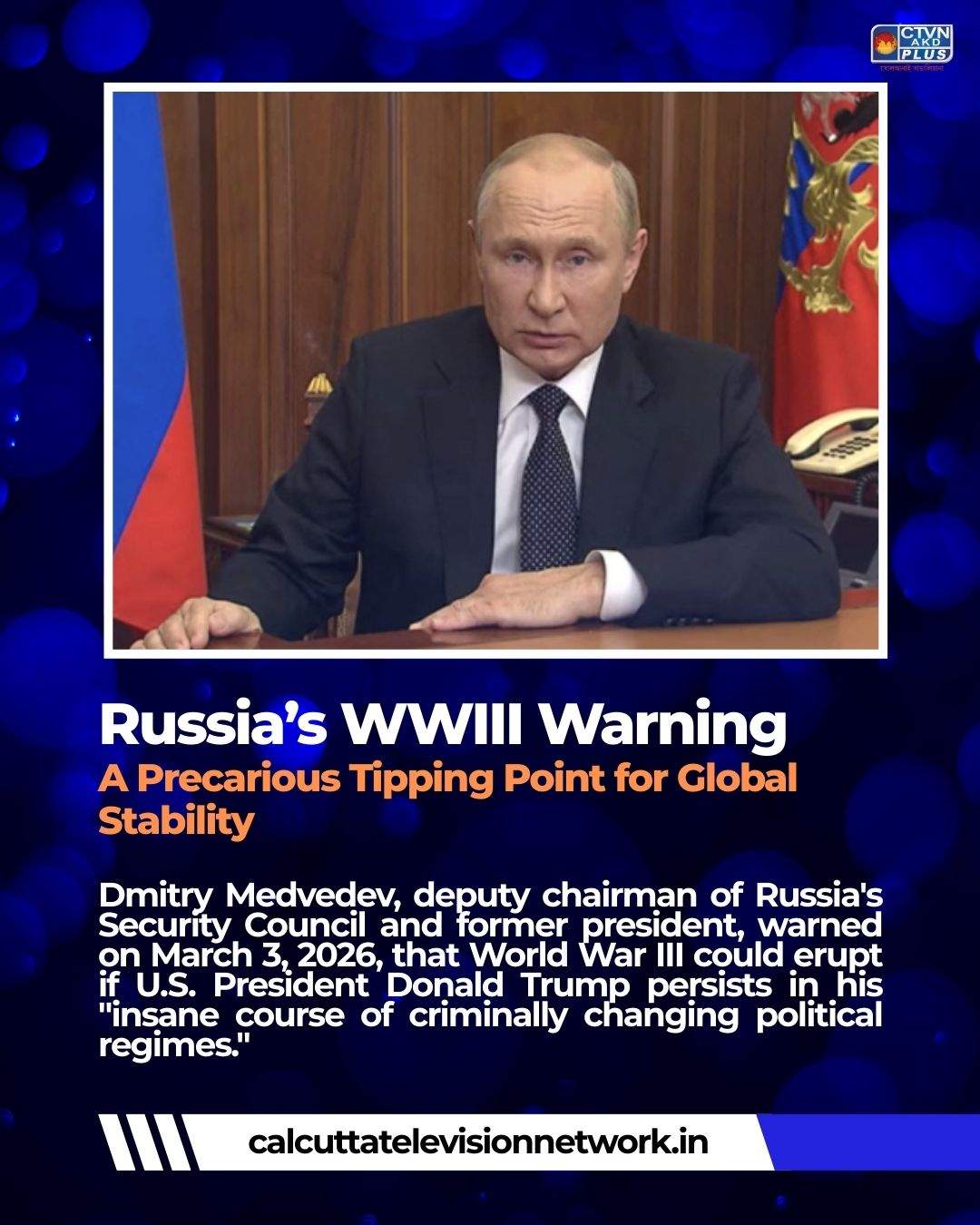
Russia’s WWIII Warning: A Precarious Tipping Point for Global Stability
In a stark escalation of geopolitical rhetoric, Dmitry Medvedev, deputy chairman of Russia's Security Council and former president, warned on March 3, 2026, that World War III could erupt if U.S. President Donald Trump persists in his "insane course of criminally changing political regimes." This statement, issued amid intensifying U.S.-Israeli military strikes on Iran, underscores the fragility of international relations in a multipolar world already strained by ongoing conflicts.
The context is rooted in the Iran-Israel conflict, which has metastasized into a broader regional war. Following U.S. and Israeli airstrikes on Iranian targets, Tehran has retaliated with missile and drone attacks on Gulf states, Cyprus, and Lebanon. Medvedev's warning highlights Russia's alignment with Iran, viewing U.S. actions as illegal interventions that echo past regime-change operations, such as the recent American capture of Venezuela's leader. He emphasized that "any event could be the trigger," pointing to heightened vulnerabilities for U.S. and Israeli officials since Iran's declaration of holy war.
For global stability, the implications are profound and multifaceted. Economically, the conflict threatens to spike energy prices, disrupt supply chains, and exacerbate inflation, as seen in reactions from nations like Japan, Canada, and Britain. Politically, it risks drawing in superpowers: Russia's support for Iran could clash with NATO alliances, while China's neutral stance might shift if trade routes are imperiled. The specter of nuclear escalation looms large, with Medvedev noting Iran's accelerated pursuit of nuclear capabilities in response to attacks. This comes against the backdrop of the four-year Ukraine war, Gaza hostilities, and Trump's provocative policies, including threats over Greenland, amplifying fears of a cascading global crisis.
Humanitarian fallout includes potential refugee waves and instability in the Middle East, testing international institutions like the UN. Medvedev's dire prediction serves as a call to de-escalate, urging restraint to avert a broader conflagration. Yet, with tensions at a boiling point, the world teeters on the edge—diplomacy must prevail to safeguard stability in this volatile era.


